
82% of SMEs fail due to cash flow issues, despite good profits
Your business is showing strong profits on paper, customers are placing orders, and growth seems inevitable. Then one morning, you can’t make payroll or rent. Suppliers are demanding payment, but your biggest customers haven’t paid their invoice yet. Within weeks, you’re forced to close and become another casualty in a common statistic.
Cash flow is the single greatest threat to small business survival, claiming more companies than competition, lack of demand, or even poor products.
Why Cash Flow Matters More Than Profit
Effective cash flow management ensures that your business has sufficient working capital to meet its short-term obligations and fund ongoing activities. Without positive cash flow, you can’t cover expenses or invest in growth, regardless of how profitable your business appears on paper.
A cash flow gap happens when money leaves your business faster than it comes in. For example, you may need to pay staff and suppliers this week, but your customers will only pay you next month. Even if your business is profitable, this timing mismatch creates a gap between outgoing and incoming cash.
The bigger the gap, the more pressure on your bank account. If it is not managed, the business may struggle to cover everyday expenses, no matter how strong sales look on paper.
Businesses that maintain positive working capital have greater ability to withstand financial challenges and the flexibility to invest in growth after meeting short-term obligations. This financial cushion is essential armor against the unpredictable nature of business cash cycles.
Hidden Cash Flow Killers You May Have Missed
1. You Are Not Getting Paid Fast Enough
Your biggest enemy might just be the slow-paying customer.
Be paranoid about collecting money. That 30-day payment term may be industry standard, but it could be costing you your business if money isn’t recovered fast enough.
Invoice immediately! Don’t wait until the end of the month. Invoice the moment goods are delivered or services are completed. This single change can dramatically improve your cash position.
Schedule regular, systematic collection calls. Your follow-up process should be as reliable as your delivery process. Put in systems and personnel to monitor your Accounts Receivable, and implement protocol to chase for late or due payments.
Collect pre-payments whenever possible. Get money upfront through deposits, retainers, and advance payments.
Automate payments instead. Set up automatic invoicing for regular clients, enable online payment options with autopay features, and use payment processors that offer recurring billing capabilities. This ensures faster payment collection that improve overall cash flow forecasting and stability.
2. Under-Charging
To stay competitive, many business owners price their products or services purely based on others in the industry, not what they need to charge to stay healthy. Under-charging is essentially paying customers to take your products.
3. Inventory Mismanagement
Money sitting in unsold inventory is money that can’t pay your bills. Make sure that you have tight and good controls on your inventory:
Track Inventory in Real Time with Software / Technology: Adopt inventory management systems that offer real-time visibility. These tools can monitor stock movement and help you avoid overstocks.
Clear all your old stock: Run promotions and bundles to move slow items
ABC Method: Focus on your top 10–20% best-selling products. Track these closely, reorder earlier, and keep higher stock levels. For slow sellers, keep just a small amount or only order when needed.
4. No Safety Net
Build up an operating reserve for at least 3 – 6 months. Think of it as a financial cushion that lets you breathe when the unexpected happens. Even a short reserve gives you the flexibility to cover payroll, rent, and supplier bills if customer payments are delayed or sales slow down.
This buffer also protects you from making rushed, risky decisions. It gives you time to look at your options and respond calmly.These savings can make the difference between staying open and shutting down when cash flow gets tight.
If You Are Looking For Funding
Have you checked for eligible grants?
Two key initiatives stand out for businesses looking to scale their operations: the Market Readiness Assistance (MRA) Grant and the Enterprise Development Grant (EDG)
MRA Grant Benefits:
Overseas market expansion support – Covers up to 70% of qualifying costs
Per-market funding – S$100,000 available per new market entry
Activity Scopes – Includes market research, business development, and promotional activities
EDG Grant Benefits:
Business transformation support: SMEs can receive up to 50% support, and 70% support for sustainability-related projects
Strategic modernization: Valuable for established businesses seeking operational upgrades
Activity Scopes: Third-party consultancy fees, software, equipment, and internal manpower cost.
Do you qualify?
Business registered and operating in Singapore
Minimum 30% local equity held by Singaporeans/PRs
Demonstrate capacity and financial readiness to complete proposed projects
For Singapore businesses contemplating expansion or transformation, these grants represent significant opportunities to accelerate growth while minimizing financial risk, reinforcing the nation’s commitment to nurturing a dynamic and competitive business ecosystem.
Find more available grants here
Financing Options If Grants Are Not For You
When government grants aren’t available or suitable for your business needs, entrepreneurs face a fundamental choice between debt and equity financing.
Each option presents distinct advantages and trade-offs that can significantly impact your company’s future trajectory and ownership structure.
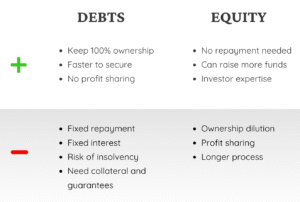
The choice between debt and equity ultimately depends on your business stage, growth ambitions, risk tolerance, and willingness to share control. Many successful businesses use a combination of both financing methods at different stages of their development.
Cash Flow Forecasting
Cash flow forecasting can help predict how much money will come in and go out of your business in the future. We can be overly excited and hasty with our projections, but remain grounded and make monthly predictions that include
- Expected sales
- Regular payments from customers
- All upcoming expenses
being as precise as possible about when payments will actually happen.
Update your forecast regularly with real numbers to make it more accurate, and always plan for the worst-case scenario by being conservative with your estimates. This helps you spot cash shortages before they happen, so you can get a loan or adjust spending in time.
The Bottom Line
Is your cash flow keeping you up at night? You don’t have to navigate these challenges alone. Our experienced team at Verti helps small businesses implement robust cash flow management systems that prevent crises before they start. You’ll have a strategic partner who helps you plan ahead and secure financing before you need it, allowing you peace of mind and more time to focus on growing your business.
Reach out to contactus@verti.sg or contact +65 6909 5691 today to discover how proper financial management can be your competitive advantage.
All information accurate as of 12 September 2025